Continuous Monitoring is Critical to Catching Intermittent Emissions
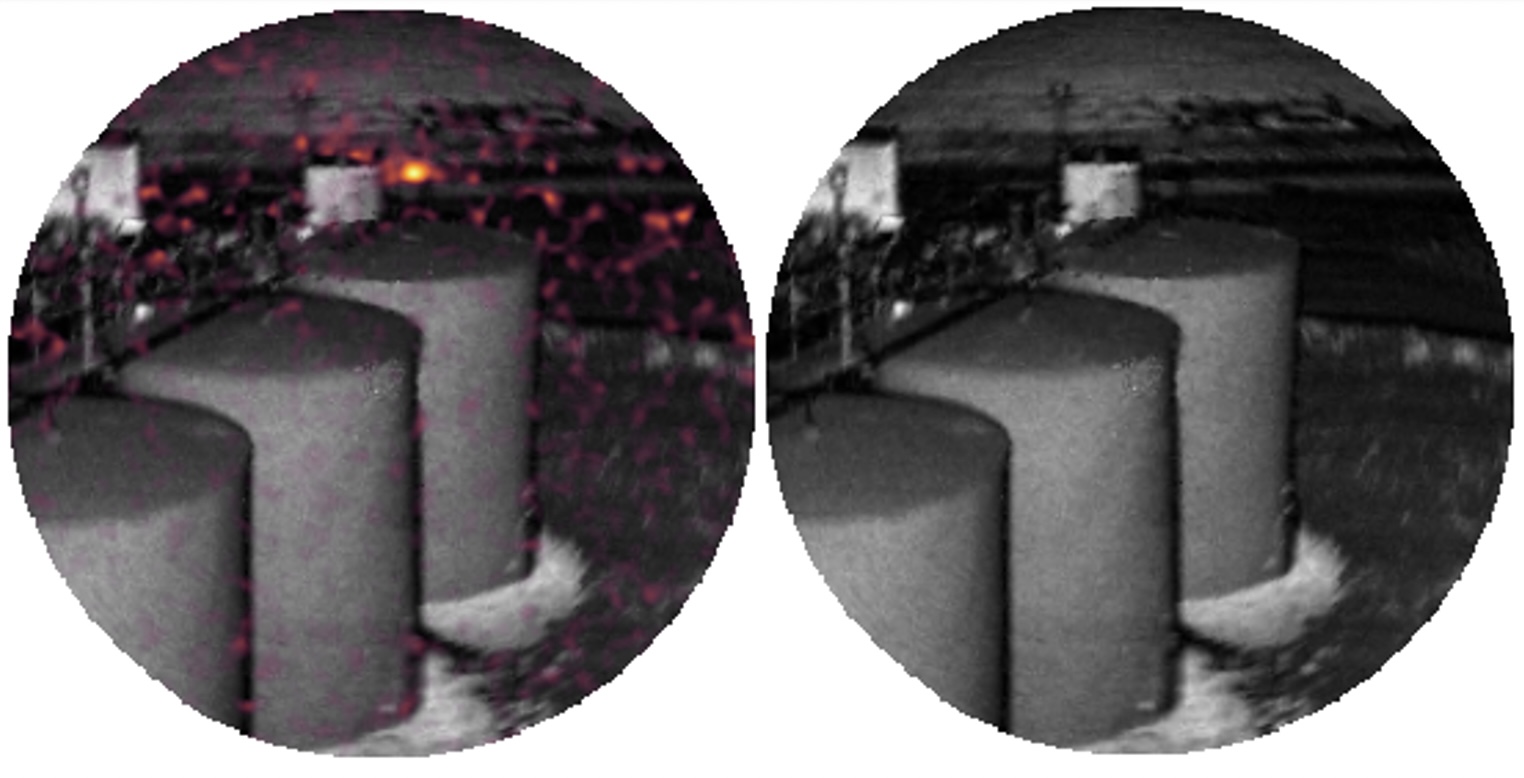
Now you see it… now you don’t! Here’s the first natural gas leak we saw with our quantum LiDAR camera at the METEC test facility this week during provisioning prior to the trial kickoff.
Many of the biggest leaks in the O&G infrastructure are intermittent like this example – to find ALL of them, you’d need watch everything all the time. While all detection & quantification technologies + methods have their place in solving the methane problem, it’s worth noting that intermittent survey methods necessarily miss some intermittent leaks – the more infrequently you measure, the more intermittent super emitters go undetected. Continuous in-situ sniffers can tell you if there’s a leak in a general area, but can’t really pinpoint it, and may miss intermittent events if the wind is in the wrong direction then. Ground-based sniffers may miss leaks from tall equipment like this leak that’s 7m in the air. Methane imagers that can’t see in the dark may miss short-lived emission events that occur at night. So what to do?
The QLM methane camera is a LiDAR, so the laser is our flashlight for seeing leaks day or night. It gives actionable imagery and quantifies, so responses can be prioritized for the largest emitters or for safety reasons. And the auto industry’s LiDAR demand is rapidly dropping the cost of LiDAR technology in general, a cost reduction curve we are riding with them. It is therefore scalable, so you could indeed watch everything, all the time.
To verifiably achieve their ESG goals, methane-intensive businesses will monitor emissions by the most credible, actionable and cost effective means. It will be a bit of a methane emissions monitoring arms race. QLM has a solution that ticks those boxes for a significant fraction of the highest-emitting O&G infrastructure. We’re excited to show what we can do!