Quantifying wastewater sludge emissions
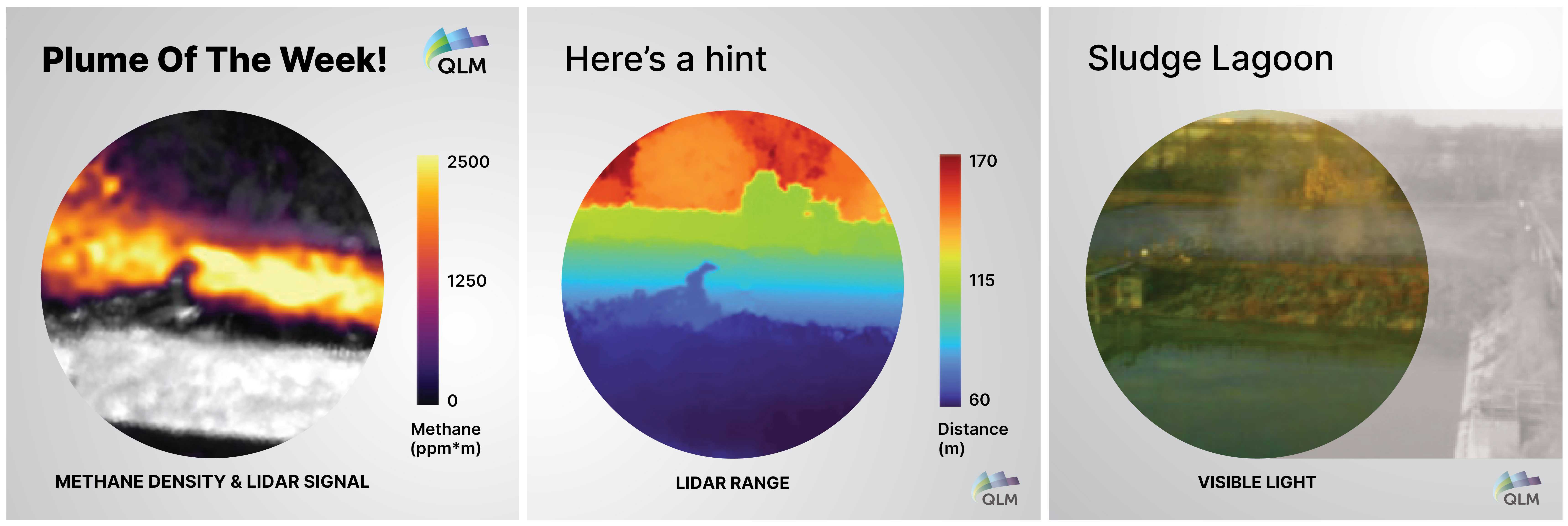
Today’s Plume of the Week is courtesy of Severn Trent Water whose Wanlip, UK Sewage Treatment Works has been the site of a months-long series of emission quantification measurements on a sludge lagoon using QLM’s Quantum Gas Lidar, installed at the site. Such sludge lagoons are a source of methane since organic matter is microbially metabolized under anerobic conditions in the lagoons. Until now it has been difficult to quantify methane emissions from lagoons due to a variety of variables. These include expected spatial variations in emissions across the surface of a lagoon and temporal variations having to do with process changes including sludge inflow, diurnal and seasonal temperature changes and changes in the maturity of the sludge. Further, sporadic ebullition of methane cannot be easily quantified by conventional methods such as floating chambers mainly because of the spatial heterogeneity of the emissions. Other methods including downwind tracer dispersion methods are plagued by reliance on specific wind conditions and geometries of the sources and sensors on a site, giving rise to measurement uncertainties and limiting truly continuous measurements of these inherently intermittent methane sources. The QLM lidar was able to image and measure these effects with the requisite sensitivity to detect and quantify even relatively small, diffuse emissions. The lidar’s ability to image the entire lagoon (and the entire methane plume as it was transported away by wind advection) shows how well suited it is for measurements of diffuse, wide-area sources.