Oil & Gas: Industrial Trials With TotalEnergies
One of QLM’s earliest industrial partners is TotalEnergies, who maintain a dedicated testing facility at TADI (Transverse Anomaly Detection Infrastructure) in Lacq, France. QLM was invited to take part in blind CH₄ emission monitoring tests run by TotalEnergies on their TADI platform in Lacq in October 2020.
These trials involve leak detection and quantification equipment being set up around a dedicated zone that contains various typical industrial infrastructure such as tanks and pipes. The site has been extensively plumbed with an array of gas supply pipes and valves so that deliberate quantified leaks from 0.01 g/s to >100 g/s of CH₄ can be released on demand. The challenge for the equipment is to demonstrate the ability to detect, localise and quantify blind releases (unknown location and unknown release rate). One “non-blind” release with known flow rate was made, for calibration purposes, after which the leak detection equipment under test needed to identify the location, and calculate the release rate, of leaks generated over the site. Data generated by our TDLidar sensor during these trials has been very promising but for now we are only able to share preliminary results.
Results
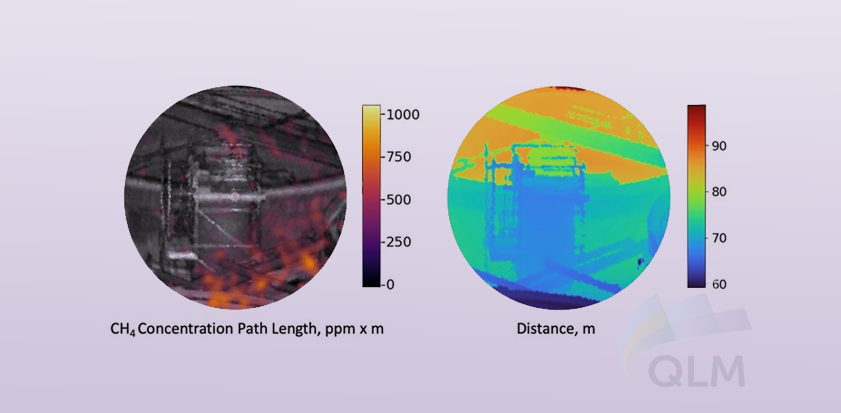
Figure 1 shows some examples of data taken in these TADI tests. Figure 1a) is an image of a CH₄ plume overlaid on a full-colour image taken with an onboard visual camera. This represents a close approximation of the automatically generated images that are provided in QLM’s commercially released lidar and clearly shows the exact location of the leak. Figure 1b and c show the TDLidar sensor’s view of large and small leaks situated about a storage tank.
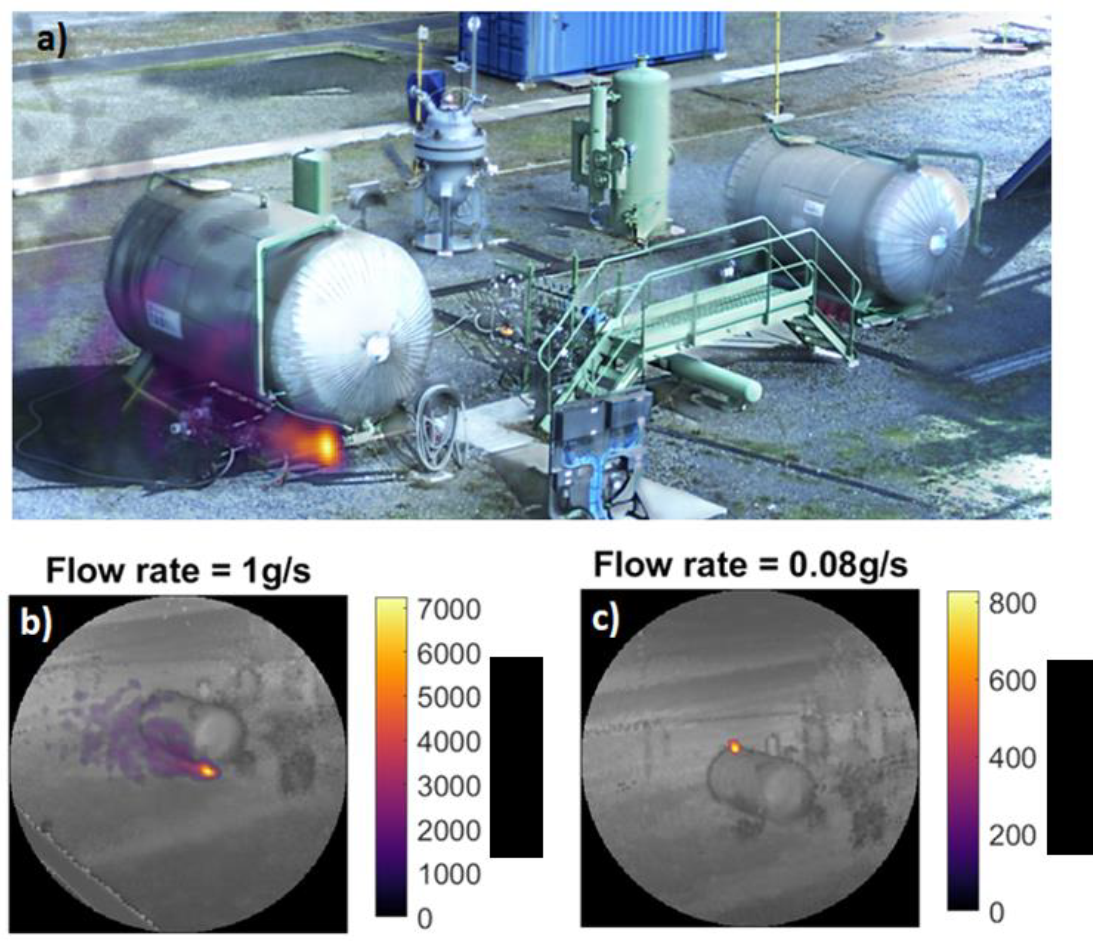
Figure 1: TDLidar images of CH4 releases test at Total’s TADI platform. a) CH₄ plume image overlaid on full-colour background image from visual camera b) and c) CH₄ ppm.m plume images overlaid on the infrared signal level image.
Conclusions
To reduce CH₄ emissions and slow global warming there is a widespread and growing need for effective and scalable CH₄ monitoring techniques that are deployable at industrial scale. Continuous monitoring of CH₄, as opposed to intermittent monitoring via surveys, offers the opportunity to enable and verify CH₄ emissions reduction programs by providing greater certainty in CH₄ budgets, eliminating estimation, and indicating where the greatest reductions can be made in the shortest possible time frame. Government regulations are rapidly changing to reflect this, and the oil and gas industry has committed to adopt a more effective CH₄ monitoring and reporting strategy.
Continuous monitoring of emissions in the oil and gas industry is a major challenge due to the stringent cost requirements of the industry and the obvious need for high durability, long lifetime, and complete autonomy. QLM’s Quantum Gas Lidar technology meets these requirements, utilising mature, robust, and highly cost effective and scalable near-infrared telecommunications components in a unique configuration for spectroscopic Lidar. The technology provides highly accurate CH₄ concentration imaging using an active scanning technique that can cover ranges of hundreds of meters. QLM is continuing to apply this technology to industrial applications with the help of end users. The quantitative accuracy of the sensor, high quality of the multiple images it captures, and lack of background interferences, makes the leak detection and quantification reliable and autonomous.
QLM’s lidar-based solution can be at the forefront of regulatory development, and provide operators with the means to both comply, and to reach ambitious Net-Zero carbon targets, on a readily available, cost effective platform.