What is Quantum Gas Lidar?
QLM has taken a unique approach to the challenge of enabling organizations to effectively monitor greenhouse gas emissions. Our patented Quantum Gas Lidar offers industry-leading performance in emission detection, quantification and localization.
QLM has developed a new type of gas sensing lidar that combines lidar and gas absorption spectroscopy with highly-sensitive, single-photon (i.e. quantum) detection. This novel imaging technology can detect, visualize, locate and accurately quantify emission rates of various gas species, notably greenhouse gases (GHGs) like methane and carbon dioxide.
QLM's unique Quantum Gas Lidar combines:
- Tunable Diode Laser Absorption Spectroscopy (TDLAS)
- Differential Absorption Lidar (DIAL)
- Time Correlated Single Photon Counting (TCSPC)
QLM uses eye-safe infrared semiconductor lasers in conjunction with a quantum Single Photon Avalanche Detector (SPAD) (Figure 1) which together acts like a “Geiger counter for light” to effectively count gas molecules in a gas plume out to distances of ~200 meters (~650ft).
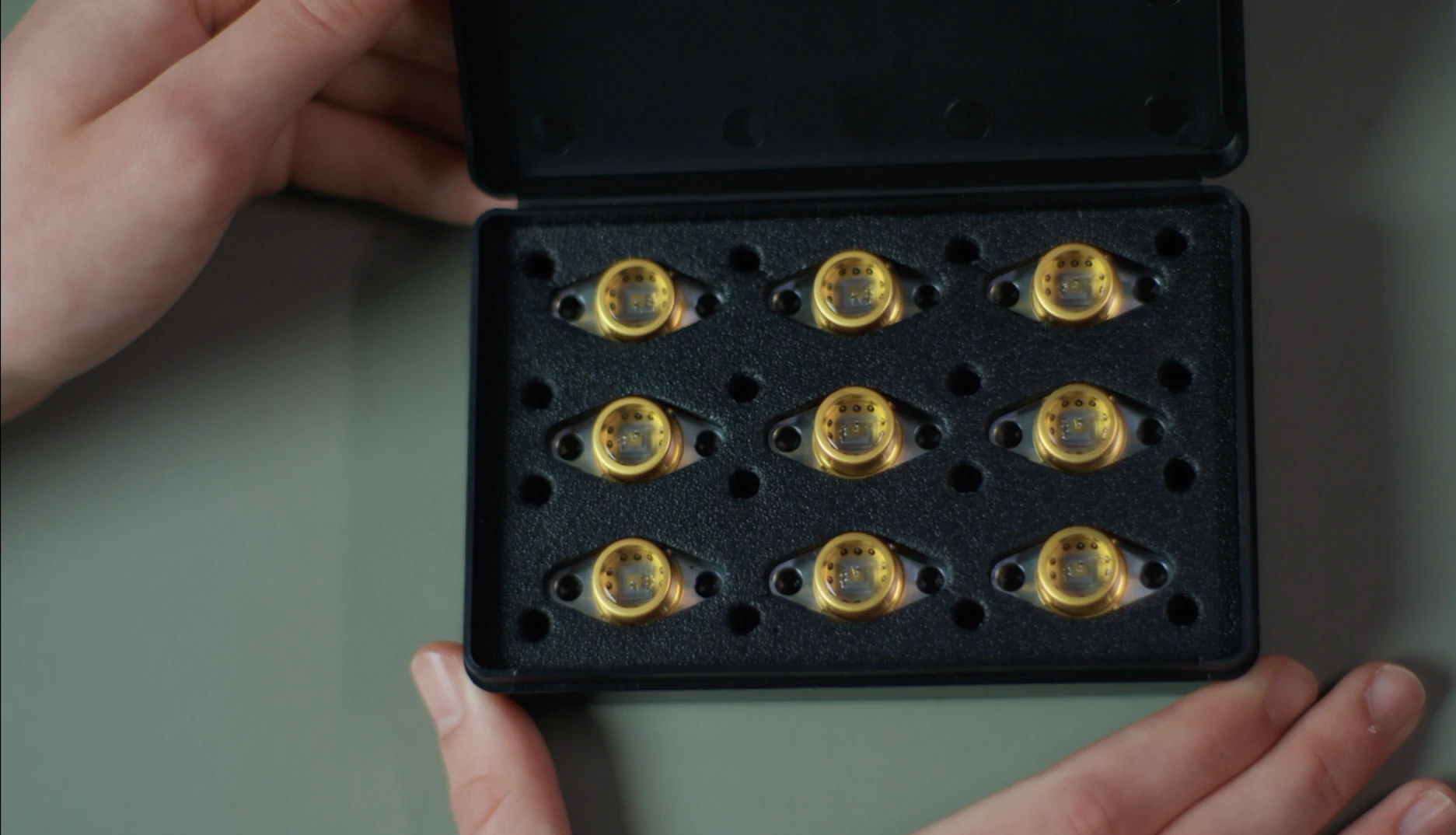
Figure 1: A quantum Single Photon Avalanche Detector (SPAD).
How does it work?
The lidar's laser is continuously tuned in wavelength over an absorption line of the gas molecule of interest, in this case methane in the near-infrared at 1651nm. The laser is simultaneously amplitude modulated with a random code and is projected by the lidar transceiver out onto objects in the distance, passing through any gas plumes between the solid object and the lidar. Light scattered off surfaces in the distance travels back into the transceiver and is detected by the SPAD.
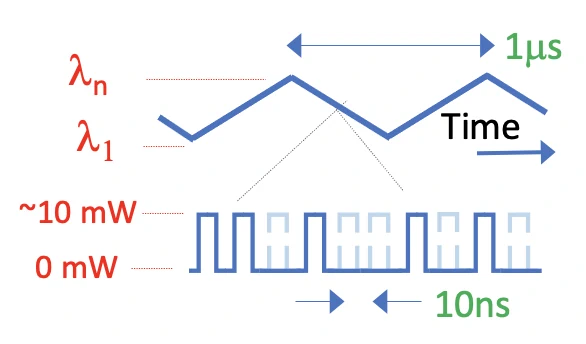
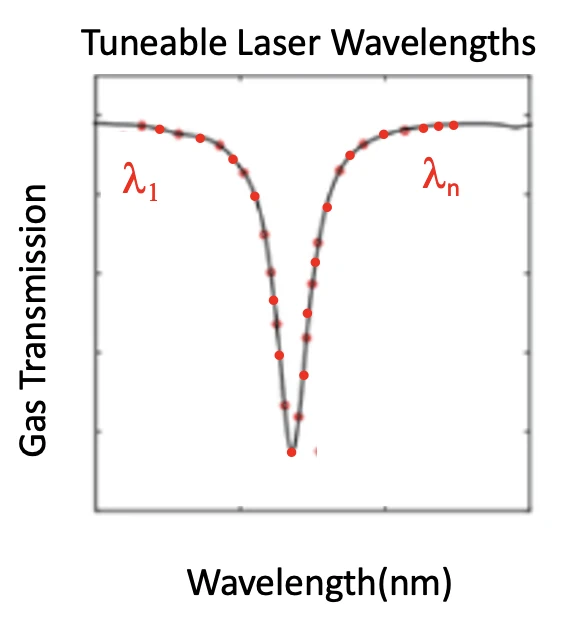
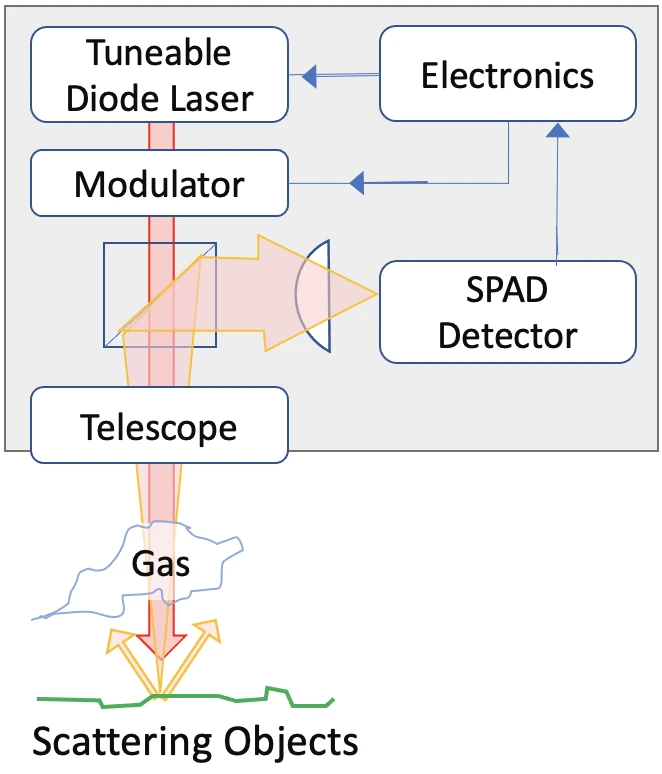
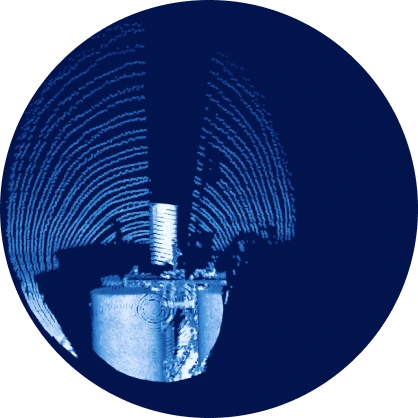
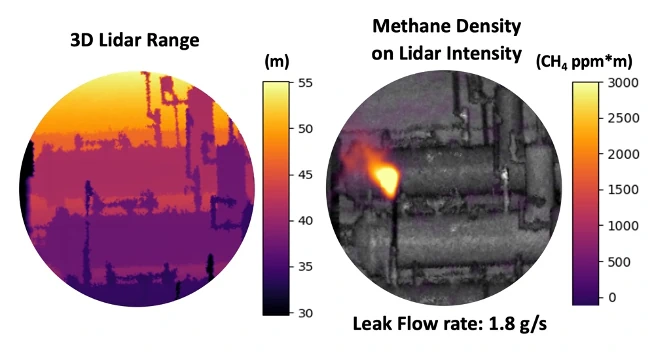
The time-correlated lidar signal gives the distance to scattering surface and using absorption spectroscopy enabled by the laser tuning, the gas concentration pathlength (ppm*m) is measured along each pointing vector of the laser as the lidar scanner - a set of rotating Risley prisms - scans the beam across the lidar's circular, two-dimensional field of view (FoV). This provides a lidar point cloud from which lidar images (lidar intensity and range) and a gas density image of any gas plume within the FoV can be produced.
Scanning the lidar's laser around a scene builds up a 3D picture (lidar point cloud) of objects and gas showing the exact plume location, shape and size.
The total gas volume is calculated by summing up the individual gas density measurements at each point and then using the lidar distance measurement to determine the physical size of the plume as seen by the lidar. To calculate gas emission (flow) rate, the wind speed and direction is measured locally with an anemometer and this data is used to calculate the volumetric flow of the gas plume through the FoV.
To date, QLM has produced lidars for detecting CH4 and CO2, and we plan to add other gas species in the near future such as ammonia.
Advantages of QLM's Quantum Gas Lidar
- Continuous, real-time monitoring - 24/7, independent of sunlight
- Can detect and visualize individual emission sources and pinpoint them with 3D accuracy
- Can quantify individual emission sources for prioritized repair
- Easy to deploy on-site (small, low power, autonomous, eye safe)
- Low-cost to scale and widely deploy
- Environmentally robust - accurate measurements in extreme conditions, even during precipitation events
- Scalable to top-tier contract manufacturers - very low cost at high volume
- QLM lidar uses many of the same components as mature vehicle lidar that saw drastic size and cost reductions over last decade
Quantum Gas Lidar vs. Legacy Optical Gas Imaging Techniques
- Detects, visualizes, locates and quantifies gas flow rates day or night and in precipitation
- Insensitive to temperatures of objects or interference from sunlight
- Extremely accurate leak quantification and 3D localization
- Methane specific (no interferences from other gases or water vapor)
- 3D imaging including range lidar intensity context imagery
- Single-photon sensitivity achieves detection at great distances
- Scalable to very low cost
- Auto-calibrating - needs no more long-term maintenance than a typical security camera
QLM Analytics - transforming lidar data into actionable information
QLM's system captures environmental and lidar point cloud data that contain a wealth of time-based, 3-dimensional and gas plume information. This rich dataset can be mined with the customizable analytics in the QLM's Emissions Dashboard solution to support a variety of operational objectives - from early warning and remote leak detection, to LDAR supplementation to emissions reporting, management and compliance for ESG or RSG initiatives. QLM's unique lidar technology not only uncovers individual sources of fugitive emissions on a facility, but it can also be used to produce a highly-credible, full-site measurement of emissions with very high time resolution for regulatory emissions compliance purposes.
To prioritize actions to address emitters, we want to know:
- What exactly is leaking (and what is not leaking!)
- How big is it?
- When did it start/end?
- Is it a vent or a leak?
- Is it expected or unexpected?
- Is it a safety issue?
- Is it caused by routine activity?
- Is it real and not from some other site or source?
- And most important of all, is it actionable - with what urgency?
Emission sources have characteristics we can measure that define their importance:
- Emission Rate & Variation
- Duration / Persistence
- Location
- Timing Patterns
QLM's analytics transform these data to prioritized actions.
QLM's technology has been thoroughly evaluated by industry and accredited third party and academic organizations. These include multiple test campaigns at the Colorado State University METEC (Methane Technology Evaluation Center) facility, multiple tests at the TotalEnergies TADI (Total Anomaly Detection Initiative) facility in France, and multiple tests at the UK National Physical Laboratory (NPL).
Learn more about the core technology
Download the technical whitepaper and product brochure for full specifications, methodology and deployment detail.
 Whitepaper
  Product Brochure